
Moey Hewitt
Department of Art, College of Fine Arts (MFA)
Salient Surrender
My work originates from lived experiences shaped by environmental awareness and material scarcity. Growing up surrounded by the landscapes of Florida, I played outdoors among pine, palm, banana, and magnolia trees. The surrounding landscape became my playground, my studio, and my economy. Fallen branches and leaves were not waste but resources and record-keepers: gifts that could be transformed into forts, crafts, and systems of exchange. These early encounters with the material life of plants shaped how I see the world and continue to inform my practice today.
Rooted in ecofeminism and Indigenous worldviews, I approach the earth as a gift. I work with fallen or dead plant matter for its distinct material qualities. Rather than frame nature as something distinct from the self, as was done in traditional landscape painting, I use natural materials in a manner that allows them to speak for themselves. Dirt is not merely a stage upon which we act, but a palimpsest of histories, an active archive of memory. Pine needles, too, are not debris to be cleared away; they form soft beds for insects, feed the soil as they decompose, and embody the cycles of life that connect all beings.
I work primarily in expanded forms of painting, using found natural materials like vines, bark, and palm sheaths in processes of weaving, stitching, and assembling. By using natural materials themselves, I position my work as an expansion of landscape painting. I recontextualise remnants of nature to create forms that evoke repair, balance, and collective resilience. My practice is an ongoing dialogue with the landscape, an act of remembering, protecting, and reimagining our relationship to the living world.
Artwork Description:
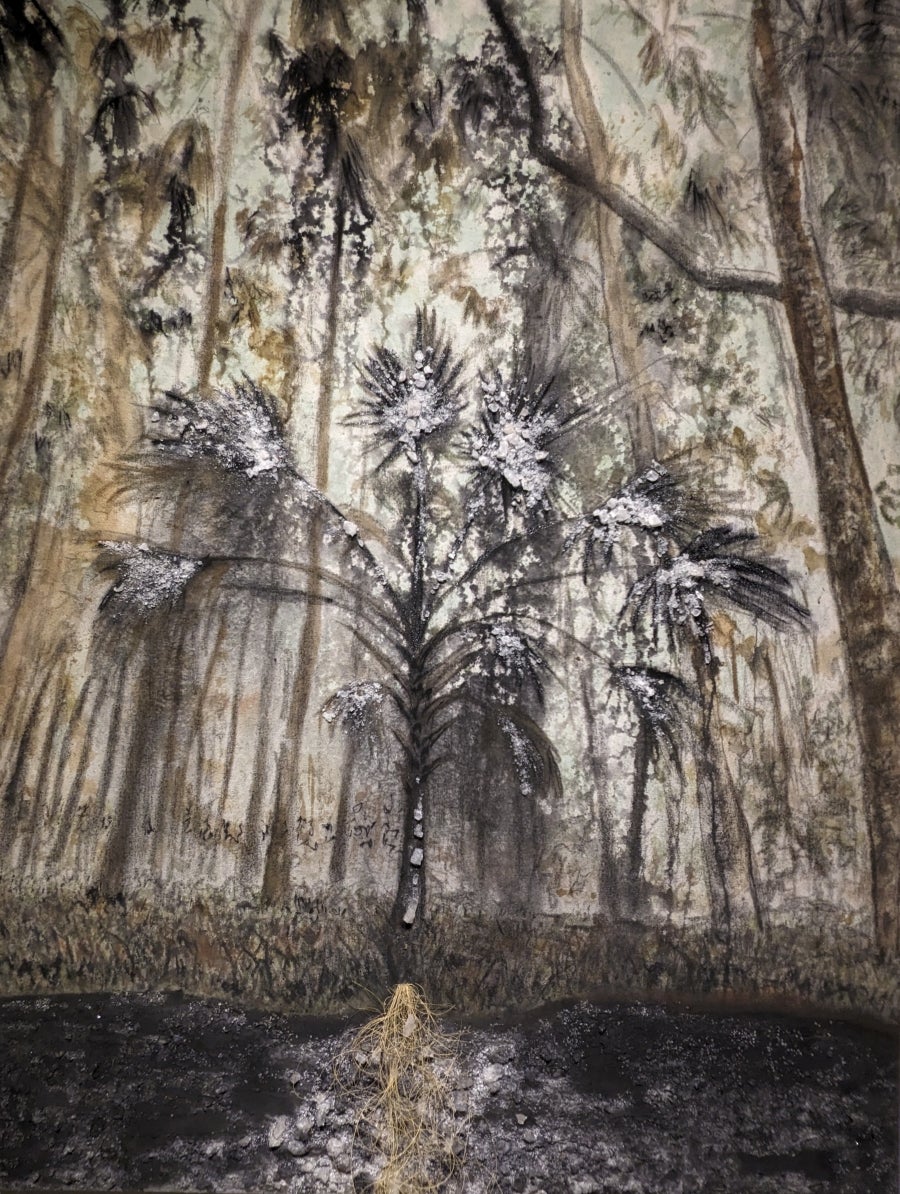
In The Palmetto Book, Jono Miller describes the cabbage palmetto as a symbol of resilience along Florida's Big Bend coast: its mature canopy appears abundant, yet it is not producing a new generation. Rising sea levels and increased salinity inhibit the establishment of young palmettos, creating a quiet ecological rupture. This painting responds to that imbalance through subject matter and material process. The pigments, inks, and fibers are derived directly from the cabbage palm itself. By embedding the tree materially within the work, the painting functions as both representation and residue, an index of the species it depicts.