
Emma Quintana
Department of Art Education, College of Fine Arts (MFA)
1973-2022
I am an artist, educator, and researcher working at the intersection of digital fabrication, material culture, and feminist inquiry. My practice is informed by years of teaching in studio and makerspace environments, where I witness how tools, systems, and institutional norms shape whose bodies, voices, and labor are made visible or rendered invisible.
My work is driven by questions of bodily autonomy, care, and containment, particularly as they relate to women's labor and representation within both physical and digital systems. I am interested in how bodies are disciplined through design: boxed, optimized, rendered, and regulated. Drawing from feminist theory, critical making, and lived experience, I examine how domestic labor, reproductive rights, and emotional work are normalized as private burdens while being structurally enforced by larger political, technological, and economic frameworks. Collaboration and participation are central to my process, allowing personal anxieties and collective histories to surface through shared acts of making.
I primarily work in digital fabrication and material-based processes, including 3D printing, metal casting, ceramics, and glass. I often translate digital forms—models, data, or text—into heavy, permanent materials to expose the tension between virtual disposability and physical consequence. When working in ceramics and cast metal, I use functional or architectural forms as sites of critique, embedding narratives of care, control, and resistance into objects that occupy everyday space. Together, these mediums allow me to interrogate how systems touch the body and how making can become an act of reclamation.
Artwork Description:
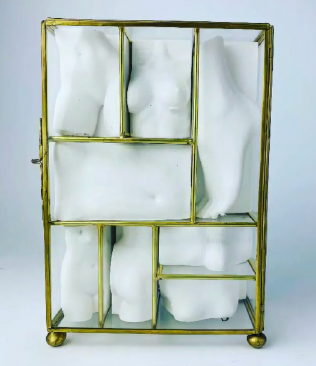
1973–2022 is a 3D-printed artwork responding to the loss of bodily autonomy following the overturn of Roe v. Wade. The work features fragmented female forms contained within a brass and glass structure, evoking systems of surveillance, preservation, and control. The bodies are boxed, constrained, and dissected, rendered as objects rather than agents. Through transparency and confinement, the piece confronts the violence of containment and the reclassification of bodies as sites of regulation. The work marks a rupture in time, holding autonomy suspended between visibility and captivity.